Horticultural fleece for frost: weights, fitting and limits
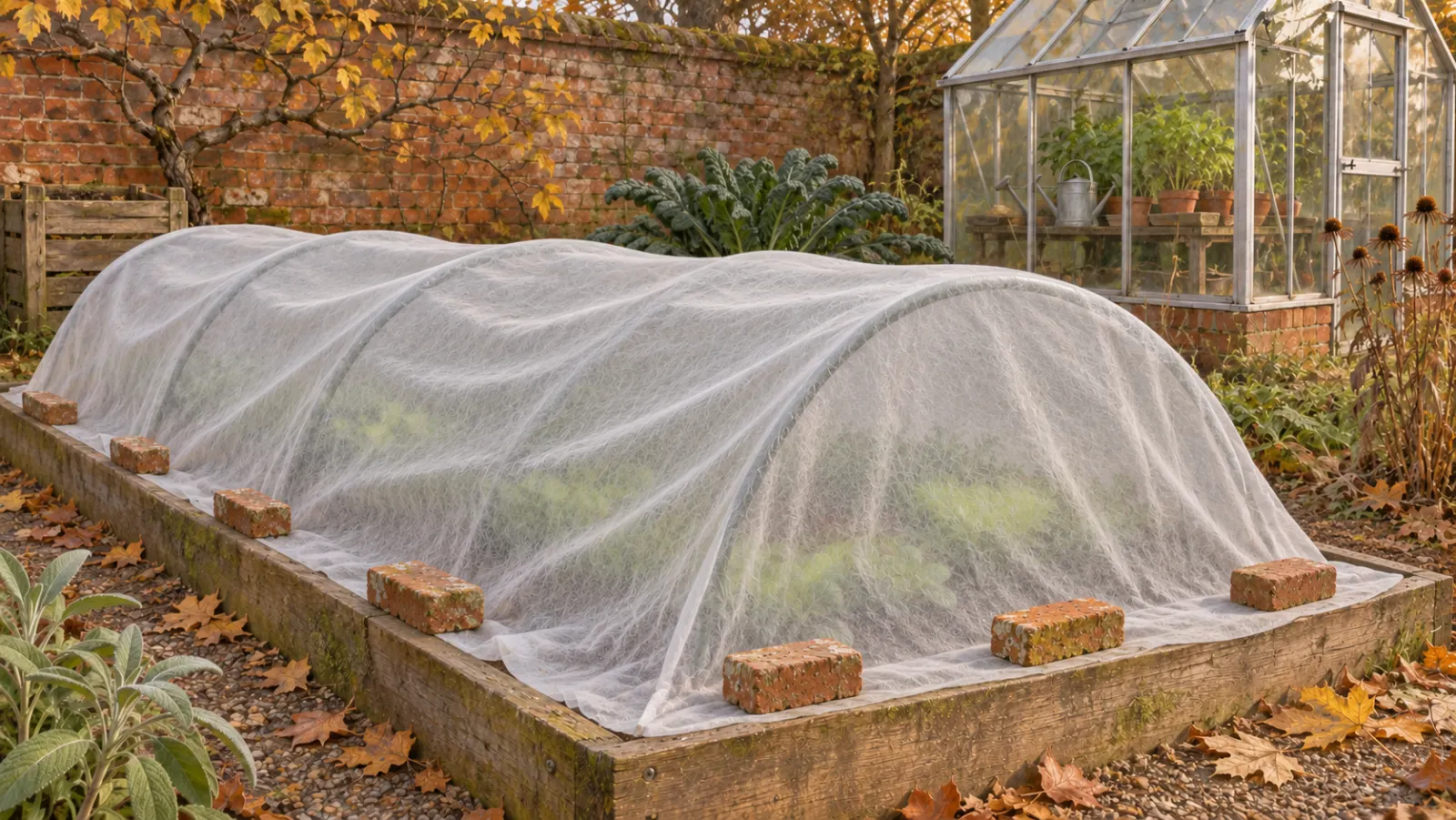
For winter frost protection, choose a reusable 30–35 g/m² horticultural fleece sheet. Keep lightweight 17 g/m² fleece for bringing on spring seedlings and taking the edge off a slight frost. The weight is the mass of one square metre of fabric: higher numbers mean a heavier cover. A heavier sheet gives a useful buffer on a cold night.
The temperature on the packet can be confusing. One roll promises protection to −3°C, another to −6°C. Choose the grade for your plants, then measure enough fabric to reach over them and down to the ground.
Which weight of garden fleece should you choose?
For an outdoor bed or a group of pots in a typical UK winter garden, 30–35 g/m² is the sensible starting point. The extra weight trades some light for insulation; a light sheet is better when growth and daylight matter most. Use 17 g/m² for spring growth and heavier grades for winter covering. The table gives published outside-temperature guidance; the −2 to −3°C range applies to 30 g/m².
| Situation | Grade | Published cold guidance | Action |
|---|---|---|---|
| Spring lettuce seedlings | 17 g/m² | Just below freezing | Drape loosely; uncover in warmth |
| Winter salad bed | 30–35 g/m² | 30g: around −2 to −3°C | Cover; anchor every edge |
| Large potted bay | 70 g/m² jacket | Around −5°C | Insulate pot; unwrap mild spells |
| Pelargoniums | Frost-free shelter | Before the first frost | Move inside |
These temperatures describe cover guidance, not the hardiness of the named plants. A zip or drawstring jacket is worth having for a large specimen that is awkward to wrap. Measure from the crown top down to the container rim, across the widest part of the crown and around it. Choose a jacket taller and wider than the plant so it closes without squeezing the growth.
Compare like measurements: a jacket’s flat width is not its diameter or full circumference. If only flat width is given, twice that width gives its approximate girth; choose a larger size if it would be snug. For several small pots or a vegetable bed, buy a sheet: it is easier to lift for watering and covers the group without buying a coat for every plant.
How many degrees of frost protection does fleece give?
Allow for roughly 2°C of extra protection from heavier fleece, the RHS’s general advice. Published lowest-temperature guidance for 30 g/m² ranges from −2 to −3°C in quoted expert advice to −5°C in a raised-bed guide. Sales claims for individual products reach −5°C and −6°C. Those are marketing claims for outside temperatures, rather than measured temperature gains for every garden. Fleece slows heat loss instead of producing heat: the warmth stored in the soil helps during a short cold night, but the covered space cools towards outside temperature without fresh heat from the sun.
Act before the thermometer reaches zero. Forecasts give air temperature; on clear, calm nights the ground and leaves can be colder. With 0–4°C forecast, little cloud and light winds, ground frost is possible. Cover vulnerable outdoor crops before dusk when those conditions are expected.
Our conservative planning rule is one 30–35 g/m² sheet for a brief overnight frost down to about −2°C air temperature, over outdoor plants that need an extra buffer. Colder than that, or freezing through the day, means a second layer for hardy crops and frost-free shelter for less hardy pots. Plants requiring frost-free winter quarters go inside before the first frost. The −2°C figure is an escalation trigger, not a plant survival rating.
Put a minimum thermometer at leaf height under the cover and a second outside it. Read both the next morning: the inside minimum tells you what the plants experienced, and the comparison shows how your cover performed that night.
Adding another layer is worthwhile when you need more protection, especially inside a cold frame. Keep spare fleece ready; the extra layer has no fixed temperature rating.
Buy enough width, and budget for reusable material
Reuse a sound sheet you already own. For a new winter sheet, choose plant-based fleece in the weight and size you need; plant-based materials and sheep’s wool are alternatives to plastic fleece. If buying reusable plastic fleece, look for UV stabilisation, tear resistance and washability. Traditional nonwoven fleece is often polypropylene, while some products use polyester. Read the material description before paying extra for an “eco” label.
For a modest bed, a useful November 2026 budget is roughly £15–£21 for a 10 m length about 2 m wide, before delivery. Two examples are 30 g/m² fleece at £14.99 for 2 × 10 m and plant-based 30 g/m² fleece at £20.99 for 2.1 × 10 m. That is about 75p and £1 per square metre respectively. Buy on the dimensions and material you need, not a claimed minimum temperature.
Measure with a tape running from the anchoring point on one side, over the tallest plant or support, to the anchoring point on the other. Allow slack for growth and enough length to close both ends. A roll as wide as the bed won’t cover much once the crop stands up.
Say your bed is 1.2 m across, with flat-topped supports 0.4 m high and 0.2 m of fabric for anchoring each side. You need 1.2 + 0.4 + 0.4 + 0.2 + 0.2 = 2.4 m across. A 2 m roll is too narrow: choose a wider sheet. For rounded hoops, measure over the curve with your tape.
Wider sheets are readily available: 2 m and 4 m widths with lengths of 10, 25 or 50 m are one supplier’s options; its 4 m fleece has a join. Cut a large sheet with sharp scissors if it saves waste, but keep useful spare pieces for a second layer.
Fit fleece over a vegetable bed before the frost
Fit the cover in daylight before the forecast frost arrives, while the bed still holds some warmth. As well as frost, an anchored cover shelters plants from wind and small hailstones. For a quick overnight cover, drape fleece directly over low plants, leaving it loose enough for growth. Choose hoops for fragile seedlings or a cover that will stay up for longer.
- Remove anything sharp that will snag the sheet. Smooth plastic plumbing pipe makes a simple hoop.
- Leave at least a few centimetres between leaves and a supported cover. Let the sides and ends reach the soil.
- Weight the edges with bricks or use fleece pegs. Leave one side easy to open for harvesting and weeding.
- After a windy night, put lifted edges back and replace torn sections.
Burying the edges is cheap and secure, but tedious when you need to get underneath. Bricks are a better default for a small kitchen-garden bed. Lay them on spare fabric at the edge so they hold it without pulling it drum-tight.
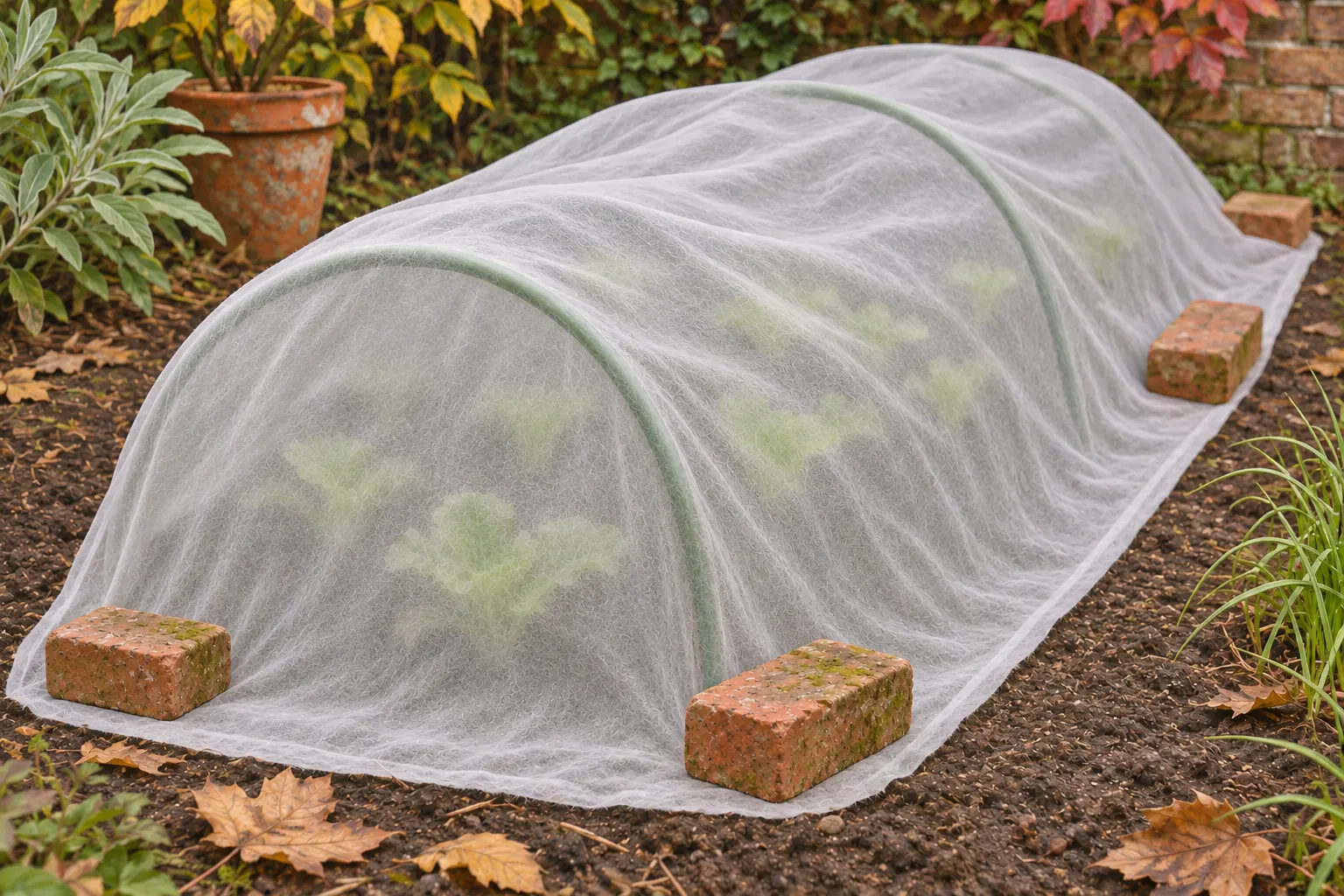
With a gap of at least a few centimetres, a supported cover can stay over a crop for weeks or months. That makes supported fleece suitable for covering an overwintering bed, provided you open it regularly to inspect the plants and lift it in warm weather. Direct-draped fleece should come off as soon as the weather improves, because it cuts winter light and shelters pests. Rain usually passes through permeable fleece, but put your hand underneath to check the compost; a pot can still be dry. Open the cover to water or feed rather than assuming everything reached the roots.
Unwrap evergreens during mild winter spells so they get daylight. After prolonged wrapping, choose a cloudy day to uncover them; if that isn’t possible, remove layers 24–28 hours apart to ease the change in light.
Protect a potted bay from the roots up
Start with the pot. Roots can still suffer in a waterlogged pot standing in an exposed corner, however well you wrap the crown. Group pots in a dry, sheltered place and insulate containers with bubble polythene or straw. Keep drainage holes clear and raise the pot on feet or bricks. Bubble wrap belongs around the container; use breathable fleece over the foliage.
For a standard bay, loosely wrap the exposed stem, then drape fleece around the crown and fasten it with string. A small folded opening at the top lets moisture escape. Use a frost-proof pot, and avoid tying string so tightly that it cuts into growth. This nursery demonstration of wrapping a bay shows the order clearly.
Use a second cover inside an unheated greenhouse
In an unheated greenhouse or polytunnel, cover the plants needing help first. A sheet over a group on the staging is easy to lift in the morning and puts the extra insulation where you need it. Fleece also works inside a cold frame or beneath a cloche.
Whole-house fleece lining is an option for winter protection; clips or double-sided pads can hold it inside the structure. It also cuts light across the whole growing space. For mixed collections, keep the brighter area for uncovered plants.
Check a minimum thermometer at plant height after cold nights. An unheated house can still freeze. Pelargoniums need frost-free storage: move them to a bright frost-free place, such as a sunny windowsill or heated conservatory, before the first frost. In sheltered growing spaces, drainage still matters: waterlogged roots and excessive winter irrigation are major causes of losses.
Keep the fleece useful through spring and autumn
In spring, light fleece helps seedlings establish and covers emerging early potato shoots when late frost threatens. You can prewarm soil for a week or two before sowing; covered crops can reach harvest about two weeks earlier than uncovered ones. In autumn, temporary covers can prolong tender cropping and the display of late flowers. Leave fleece over winter root crops to help keep the ground accessible for harvesting.
Fruit blossom needs a different routine from dormant trees. Cover a small tree overnight and take the fleece off during the day so pollinating insects can visit. For wall-trained fruit, two or three layers are advised; watch for severe frost for two weeks after flowering, when young fruit can still be damaged. Use canes to keep those layers off the blossom and roll them up each day. Large trees are difficult to cover, so don’t buy a huge sheet without working out how you will place and remove it. For strawberries in flower, use a double layer overnight and open it during the day. After flowering, switch to bird netting if birds are the problem.
For summer pest exclusion, choose fine insect mesh by default: it admits air without the same warming effect and can keep birds off too. Keep fleece handy for a temporary cover if summer hail threatens delicate plants. Fleece can deter flea beetles or cabbage butterflies, but inspect underneath and open covers on crops needing insect pollination. Bird netting alone won’t keep small insects out. If heat is the problem in a glasshouse, use shade netting chosen for the light your crop needs.
When fleece isn’t enough
For an immovable specimen facing a long freeze, insulate its crown and roots as well as covering the foliage. Fleece can be combined with straw for added insulation. Find the named plant’s winter-care instructions in its RHS growing guide before packing material around the crown.
Clear heavy snow before it weighs the fleece down onto plants. Keep covers secured, drainage working and containers sheltered; extra layers alone won’t solve those problems. Check under the sheet for slugs and snails, and pull weeds before the protected bed becomes their nursery too.
Avoid wet curtains or heavy sacking resting on delicate growth. Clear heavy-duty polythene gives less frost insulation than heavy fleece. Use it on a cloche frame, ventilate to release trapped moisture and water the soil beneath it; rain cannot pass through a solid sheet. A fleece sheet is usually easier to lift and dry after an overnight cold snap.
Store it so it is ready for the next cold night
Hand-wash dirty fleece gently; for material sold as machine-washable, use the gentlest cycle. Dry it fully, then fold it somewhere dry and out of sunlight. Good material can last several seasons, while thin plastic fleece may fall apart after one. Replace a sheet once it becomes brittle or starts shedding fragments. For repeated spring crop covering, a woven cover is another option: woven polythene mesh such as Envirotect can last at least five years, with claimed properties similar to light 17 g/m² fleece. Keep heavy fleece for the winter frost job. Plastic fleece generally lacks a household council recycling route, so collect deteriorating pieces promptly. For plant-based fleece, use the maker’s stated disposal route; compostability belongs to the particular material.
Before the next frost, leave your cut sheet with its pegs or bricks, and choose the frost-free place for any pots you may need to move. You can fit the cover in daylight instead of hunting for it after dinner.