How to reduce greenhouse condensation in winter
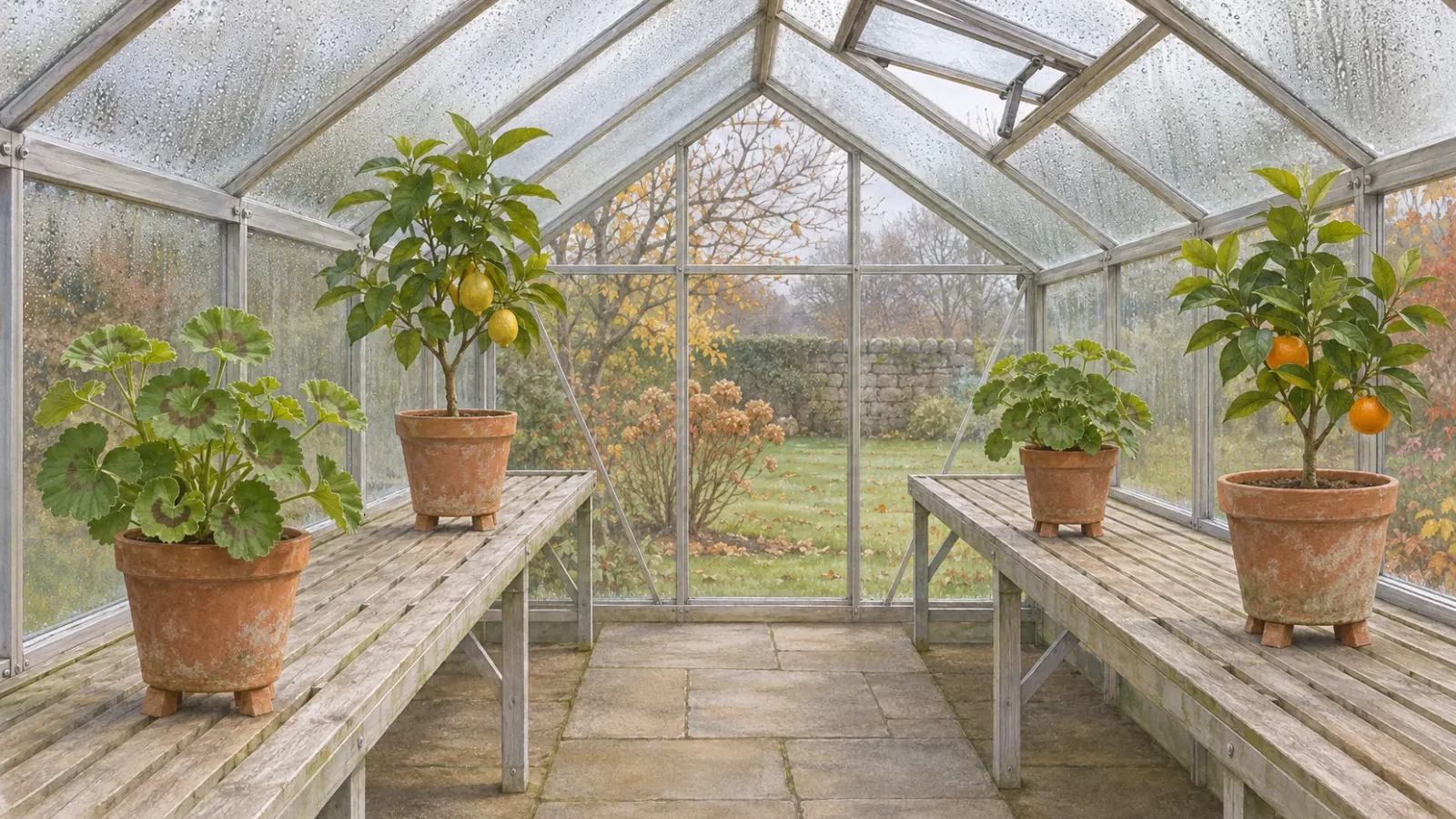
To reduce winter condensation, water the compost in the morning, keep the floor dry and exchange damp greenhouse air for fresh air during mild daylight. Space pots so leaves don’t touch. Add gentle air circulation if damp pockets remain, and use controlled ventilation with reheating in a heated house.
A misted pane on a November morning isn’t, by itself, a reason to buy a heater. Wet pelargonium leaves, dripping roofs and grey mould need attention. The aim is to get plants dry before another cold night, while keeping them warm enough to survive it.
What should you do first?
Start with the row that matches your greenhouse. A house of winter salads can be aired more freely than one holding tender plants; trying to run both by the same routine causes trouble.
| Situation | First action | Next step |
|---|---|---|
| Cold house: rocket, mizuna | Vent in mild daylight | Water roots in morning |
| Heated house: tender pots | Exchange air; restore warmth | Hold warmth at leaf height |
| Leaves stay wet; RH often above 90% | Empty water; air in mild spells | Run fan; find damp spots |
| Frost, tender pots, no heat | Move pots to frost-free light | Air in the next mild spell |
| Dawn droplets, dry leaves later | Clear drip channels | Air by day as usual |
| Wet leaves, crowded pots | Space pots; clear dead leaves | Run fan gently |
| Drips after rain | Look at joints and gutters | Repair the water entry |
| Water in panel flutes | Read panel care guide | Clear the drain paths |
Judge success by plants that dry during daylight and stay free of rot. Some condensation on cold glass is inevitable; a completely clear roof isn’t the target.
Why does a greenhouse get so wet overnight?
Condensation forms when glass, metal or leaves cool below the air’s dew point. Water evaporates from compost and wet paving during the day, and plants release moisture too. As the house cools, some of that water becomes droplets on its coldest surfaces.
For a numerical example, air at about 21°C and 70% relative humidity can condense on a surface cooled to 15°C. The room can feel pleasantly warm while a colder leaf or pane is already wet.
Heating lowers relative humidity because warmer air can contain more water vapour before saturation. A rise of about 11°C roughly halves RH in the usual greenhouse temperature range, without carrying water out of the house. Exchange moist air rather than heating solely to force a lower humidity reading. Exchanging moist air and warming the replacement air is what makes winter ventilation useful. A circulating fan helps the air reach cold corners, but leaves the water inside unless there’s an exit.
How to ventilate an unheated greenhouse in winter
Choose the mildest daylight spell for airing. In cold, gusty weather, use a smaller opening to protect tender pots from draughts. The RHS advises autumn airing while warmth allows, with less ventilation as cold winds arrive.
Use a roof vent with a side vent or a partly opened door to give air a route through. On a windy day, a wide-open door can cool the house quickly. Protect pots in the incoming stream; cold air should mix with warmer air before reaching vulnerable foliage.
Check the temperature at the plants as the house airs; reduce the opening if it keeps falling towards their winter requirement. Keep airing while the temperature allows and leaves are drying, then close down before the evening chill. Wind and vent size change how quickly this happens, so the thermometer decides when to stop.
For pelargoniums you want to keep growing and flowering, aim for 7–10°C. Close or reduce vents as the house cools towards the lower end of that range; if you can’t maintain it, use a bright, frost-free room instead. Cut-back, resting pelargoniums can be kept in a light, airy, frost-free place with barely any water until growth resumes. Warmer tropical plants need their own higher minimum: look up the named plant in the RHS Plant Finder before housing it with these pots.
For an unheated salad house, prioritise daytime drying; on a freezing day, protect the crop and wait for a milder opportunity. For frost-tender plants, arrange frost-free accommodation before a freeze; closing the door won’t create heat. Lift overnight fleece covers when conditions improve so you can inspect the plants, water where needed and release trapped damp air.
What changes if you heat the greenhouse?
Ventilate and restore the temperature, rather than turning up the thermostat in a sealed, wet house. Use controlled exchanges when humidity builds, keeping the crop’s minimum temperature as the lower limit. In a glasshouse that can mean heating while vents are open; with mechanical exhaust, it can mean a short exchange followed by reheating.
In equipped heated houses, winter ventilation commonly exchanges two to three greenhouse volumes of air an hour. Brief heat-and-vent cycles two or three times an hour around evening and sunrise are a commercial operating pattern. A cycle only counts as a full air change if it moves that volume: don’t convert either figure into minutes with a door open. For a small heated house, dry it before dusk, restore the chosen temperature and use leaf-height readings to decide whether further controlled exchanges are needed.
What humidity should you aim for?
Act on wet foliage that persists through daylight, or repeated readings above 90% RH. First remove standing water, then exchange air when you can maintain the plants’ temperature; add circulation for damp pockets. Above 90% RH, fungal diseases can develop rapidly. Dry leaves after normal daytime airing mean a high dawn reading alone is no reason to turn up the heat.
Lower figures belong to particular crops: tomato leaf mould becomes a problem above 80% RH, with little infection below 70%. Those figures explain why a warm tomato crop needs tighter humidity control than a cold house of winter salads. For mixed overwintering pots, use the drying rule above instead of chasing a universal percentage.
A timer or humidistat can make an equipped heated house more economical to manage than leaving vents cracked all night. Combustion heaters and extraction need a properly designed ventilation arrangement: exhaust fans can draw flue gases into the growing space. Don’t improvise a fan-and-heater control system around a fuel-burning appliance.
Remove the water you don’t need
Water individual pots at compost level in the morning, and skip pots whose compost is still moist. Give the roots what they need, allow drainage and empty water left in saucers. Stop damping down the floor as winter approaches. Morning watering gives foliage time to dry before the colder night; soaking staging and paving adds an avoidable moisture source.
Keep citrus compost just moist through winter, with pots standing on feet and away from cold draughts. Overwintering succulents and other resting plants also need restraint with watering. Winter salads are still growing, so don’t let their compost become bone dry in an attempt to lower a humidity reading. Water by the condition of each pot, rather than watering the whole bench because you’re holding the can.
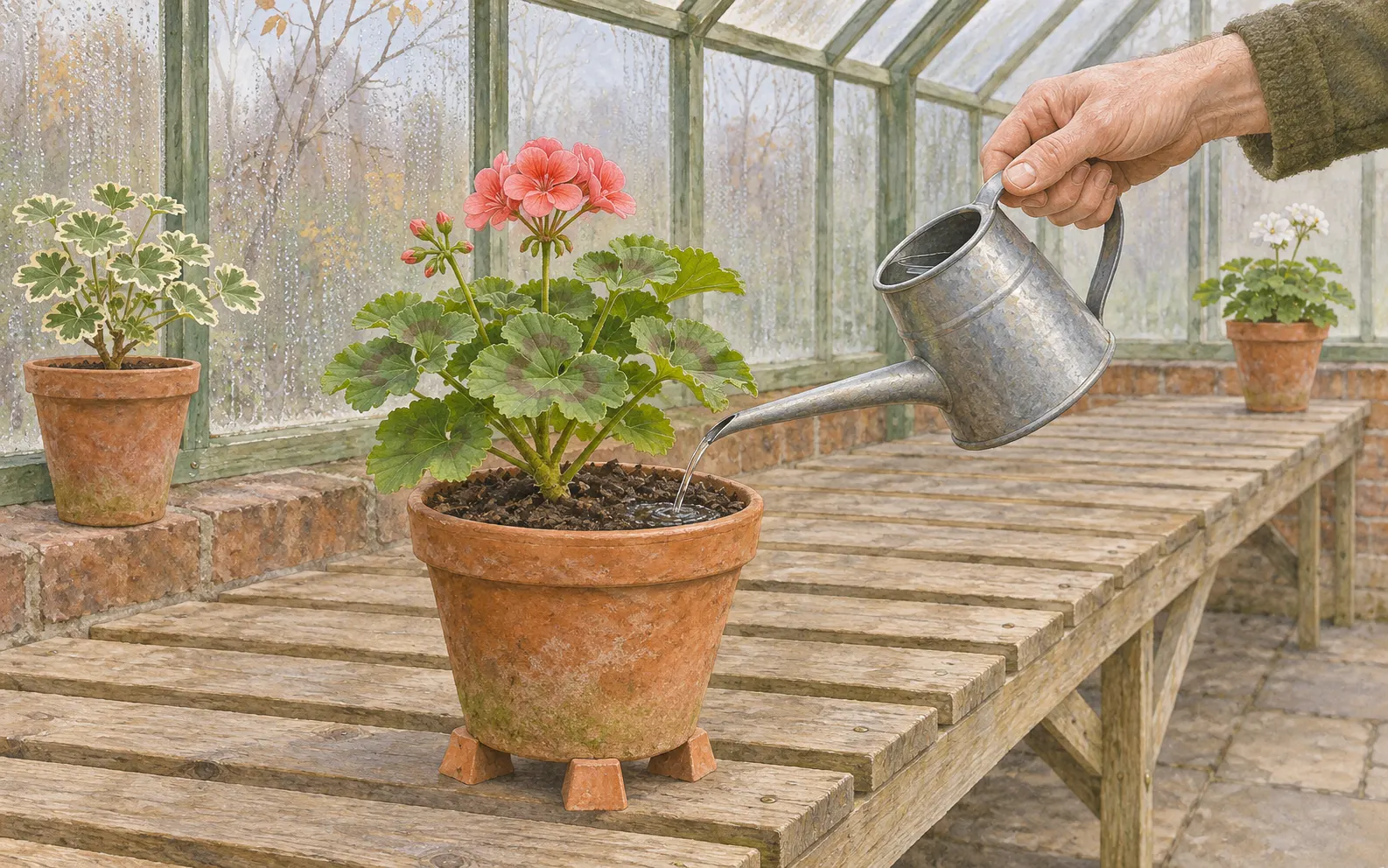
Leave a clear gap between neighbouring plants so air can pass through the foliage. Stand small pots on pieces of slate or wood so air can circulate beneath them; keep drainage holes clear. Sweep away fallen leaves and old compost, including the damp mess under staging. Clean glazing and gutters also preserve scarce winter light and keep rainwater moving outside.
If you find fuzzy grey-brown growth on dying flowers or leaves, remove the affected material carefully. Bag mouldy parts before, or immediately after, cutting them off to avoid scattering spores. Cyclamen, pelargoniums and lettuce are among the plants grey mould attacks. Airing helps reduce favourable conditions; it won’t restore rotten tissue.
Is a fan worth buying?
Yes, if plants still sit in stagnant, wet pockets after you’ve cleared water and made room between pots. Start with working vents and a min/max thermo-hygrometer: it shows both the overnight temperature and the humidity pattern. Then choose an adjustable, greenhouse-suitable circulating fan so you can set a gentle flow. Buying a large fan before clearing puddles is an expensive way to stir damp air.
Choose gentle circulation through the growing area, with placement that reaches the leaves rather than only the path below the bench. Aim for an even climate, without a hard blast at the nearest pot. Compare temperature and humidity in different parts of the house to find pockets the airflow misses. Strong airflow can dry plants excessively. Run gentle circulation through damp periods, including overnight where needed, with an unobstructed return route for the air.
A dense canopy can be 20–40% more humid than the air above it. Measure among the plants to find those damp pockets; don’t add that percentage to a reading taken elsewhere. Large-house fans and perforated air tubes distribute air over long crops; a small house needs even coverage at pot height rather than a commercial fan diameter.
Put the sensor at leaf height, shaded from direct sun and clear of wet glass, heaters and the vent’s incoming draught. Sensor placement changes how well your readings represent the crop. Keep the sensor clean and maintained, and compare it with another meter if its readings become implausible.
For a running-cost comparison, assume a 20 W fan runs for 24 hours at an electricity tariff of 25p/kWh. It uses 0.48 kWh, costing 12p a day. A 2 kW heater actually heating for one hour uses 2 kWh, costing 50p at that tariff. Use your equipment’s wattage and your own tariff: removing needless water and improving circulation are worth doing before buying extra heat.
Condensation and watering make this a wet electrical environment. Choose equipment intended for those conditions, use an RCD-protected supply and suitable protected connections, and have new fixed wiring installed by an electrician.
A wax-operated roof opener responds to warmth, with a delay. It needs other ventilation available while it responds, and it isn’t a humidity controller. A cool, wet day may still require manual airing.
When airing and circulation aren’t enough
Investigate water that keeps returning in the same place. General beading after a cold night points towards condensation; a local drip during rain calls for inspection of glazing joints, gutters and seals. Wipe reachable wet surfaces when drips threaten plants, take the wet cloth out of the house, and keep its designed condensation channels clear. Removing morning water and standing water reduces the load you have to manage.
Light misting inside twin-wall polycarbonate channels can clear in warm, sunny weather; it is a separate issue from drops on the room-facing surface. Inspect the maker’s drainage and end-tape arrangement if water pools in the channels. Don’t seal every opening in an attempt to stop moisture: the panel needs its intended drainage route.
For a replacement polythene cover, choose greenhouse film with an anti-drip treatment where roof drips are the recurring problem. The treatment encourages condensed water to run towards the eaves. For an existing cover, use only a compatible horticultural anti-drip treatment approved for that material. Keep the runoff path to the eaves clear; droplets turned into a film still need somewhere to drain.
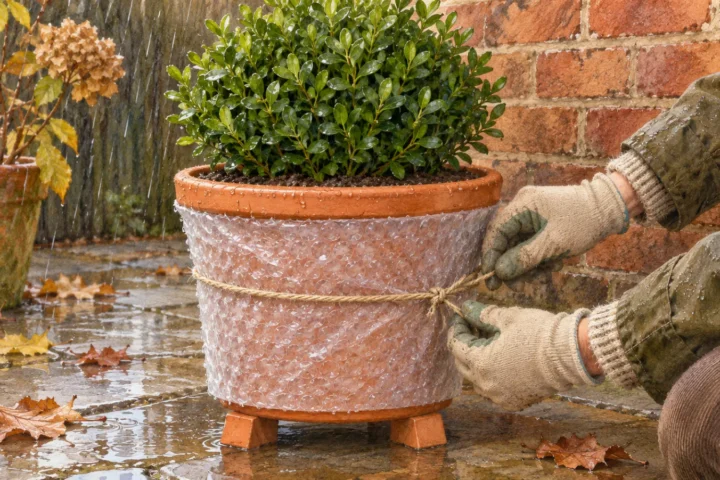
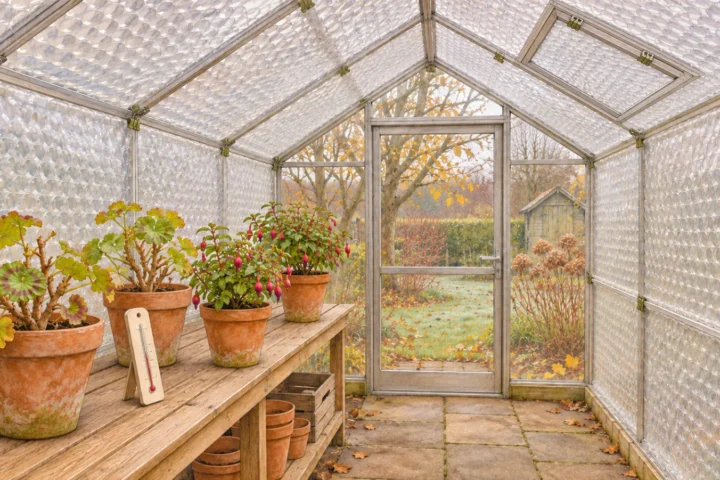
Single glazing tends to condense more readily than double glazing because it reaches the dew point sooner. Insulation can reduce heat loss, but leave vents operable and retain as much daylight as possible; remove leftover summer shading. A sheet of bubble wrap that blocks the only roof vent makes drying harder. If a gravel or paved floor remains wet, trace overflowing gutters, incoming rain and poor drainage before covering it. A membrane across a wet floor can leave you with a water problem beneath the membrane.
Watch an autumn greenhouse changeover
For winter salads, this autumn changeover puts planting, watering and ventilation into a working greenhouse routine.
Before you leave it for the night
- Empty standing water and put the watering can away.
- Remove fallen flowers and mouldy leaves; separate touching foliage.
- Close or reduce vents for the night’s forecast and the plants inside.
- Leave the minimum thermometer at leaf height.
- Next morning, look for wet leaves as well as droplets on glass. If foliage stays wet into the day, remove the water source or improve the next safe airing period.