How to Overwinter Potted Plants: Wrap, Bury or Move?
Move tender leafy plants into bright shelter before nights reach their winter minimum. For small pots of hardy perennials, the simplest reliable protection is to sink them into a well-drained bed after dormancy and before the ground freezes. If you only have a patio or balcony, use the table below to choose between wrapping and cold storage.
A daylily that sails through winter in a flower bed can lose its roots in a thin nursery pot. The same soil that keeps your garden plants alive can insulate the pots too.
Which pots should you wrap, bury or bring inside?
A trench is quicker than wrapping a collection of nursery pots one at a time. For pots that must stay above ground, the plant’s hardiness and your shelter’s actual temperature decide the route.
| Plant and situation | Winter conditions | What to do |
|---|---|---|
| Hardy daylily in a nursery pot | Dormant; garden bed available | Sink to the rim; backfill |
| Dormant hosta; no bed | 34–40°F (1–4°C); darkness is suitable | Move into a measured cold garage |
| Boxwood in a large patio pot | Two-zone hardiness margin; sheltered site | Group pots and insulate their walls |
| Evergreen agapanthus | Light; above 32°F (0°C) | Move into frost-free shelter before frost |
| Lemon, lime or other citrus | Bright; type-specific minimum below | Move into suitable bright shelter |
| Dahlia or canna in a pot | 40–50°F (4–10°C); frost-free | Lift, dry and store tubers/rhizomes |
A hardiness label tells you how a plant fares in the ground. In a pot, a lot of roots sit right against the wall, and the root ball can get nearly as cold as the air. Repeated freezing and thawing can heave the mix and tear roots. In a hard winter, exposed potting mix can fall into single digits Fahrenheit—about 0–9°F (−18 to −13°C), cold enough to kill roots even if the stems survive.
For a pot that will stay above ground, start with a cultivar rated for two USDA zones colder than your garden. In a place with an average annual extreme low of −5 to 0°F (−21 to −18°C; zone 6b), look for a label that goes down to −25 to −20°F (−32 to −29°C; zone 4b). That’s a 20°F (11°C) difference between zone bands. For labels without USDA zones, compare the plant’s published minimum with your area’s typical coldest winter nights and look for that same margin. Use the full botanical name and cultivar on the nursery’s growing guide or the RHS Find a Plant database. Bury or move anything only just hardy where you live.
In a mild maritime winter, from coastal British Columbia to Ireland and Atlantic Europe, look first for shelter from repeated rain and wind. In a colder inland winter, from the Canadian Prairies to central Europe, plan where the little pots will go before the soil freezes. Give newly potted plants time to establish before that cold arrives, and skip late doses of high-nitrogen fertilizer that push out soft growth.
Sink hardy pots before the ground freezes
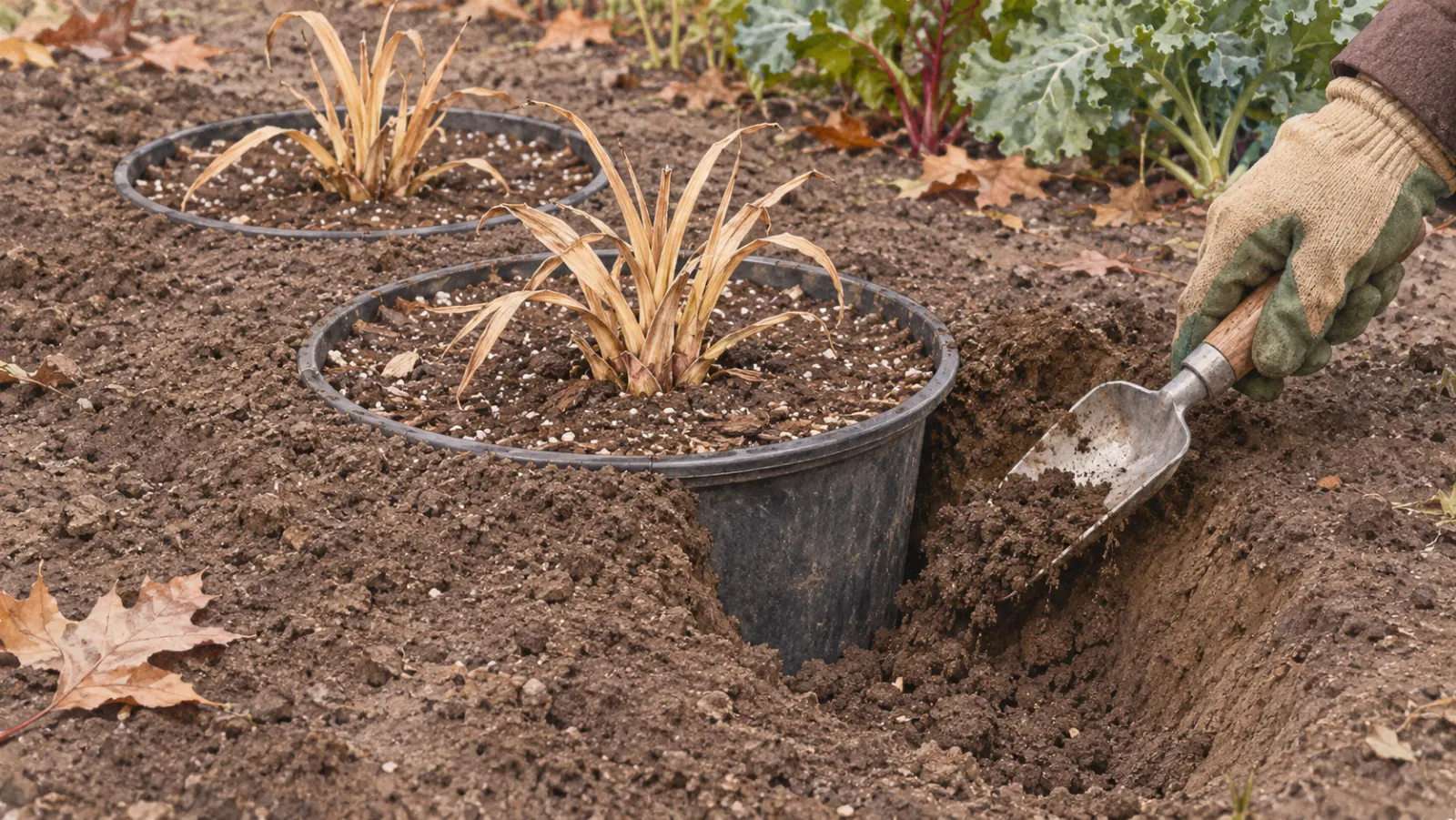
Pick a spare patch where rain soaks away rather than pooling. Once the plants are dormant, often within a few weeks of the first fall frost, dig before the ground hardens. A row of pots can go into one trench, pot to pot, so there’s no need to dig a separate hole for every hosta.
- Set each pot so the rim is level with the surrounding soil. Leave the crown of the plant at its original depth in the pot.
- Backfill around the walls. Fill the gaps; the point is to put soil against the sides that were exposed to air.
- Water if the mix is dry and unfrozen. Once buried, the pots drain more slowly, so check the mix before reaching for the watering can again.
If you’re expecting a hard winter, give dormant buried pots 6–12 in (15–30 cm) of loose straw or pine needles. Skip whole wet leaves over a perennial crown; they mat down. For woody plants, use a staked chicken-wire cage wide enough to enclose the whole plant. Place the straw around awkward branches before fitting the cage, tying the branches loosely if necessary to avoid snapping them. Pin wire over the top or tie burlap (hessian) or shade cloth around the cage to keep the straw from blowing away.
For a low bed where you don’t need a cage, 3–4 in (8–10 cm) of wood chips is another way to buffer the soil. Spread them once the surface starts freezing, usually shortly after a hard frost. Do it while the chips are still loose enough to shovel. Earlier mulching can delay dormancy and leave the soil cycling between freezing and thawing. Where animals browse, pin the wire down and keep it higher than the likely snow line. Fit a wire lid to close the top, and use a tree guard around young bark where rabbits or rodents gnaw. A loose straw cage alone won’t stop mice reaching the bark.
Set up the patio pots so they can drain
Move the group out of the wind before the first frost. Look under the eaves on the north or east side if the spot is dry and sheltered. In a cold, sunny garden that keeps the pots out of strong afternoon sun and slows thawing. In a wet garden, a dry nook on a different wall is more useful than the right compass bearing under a leaking gutter. Keep early-flowering camellias out of direct morning sun if frozen buds are a recurring problem.
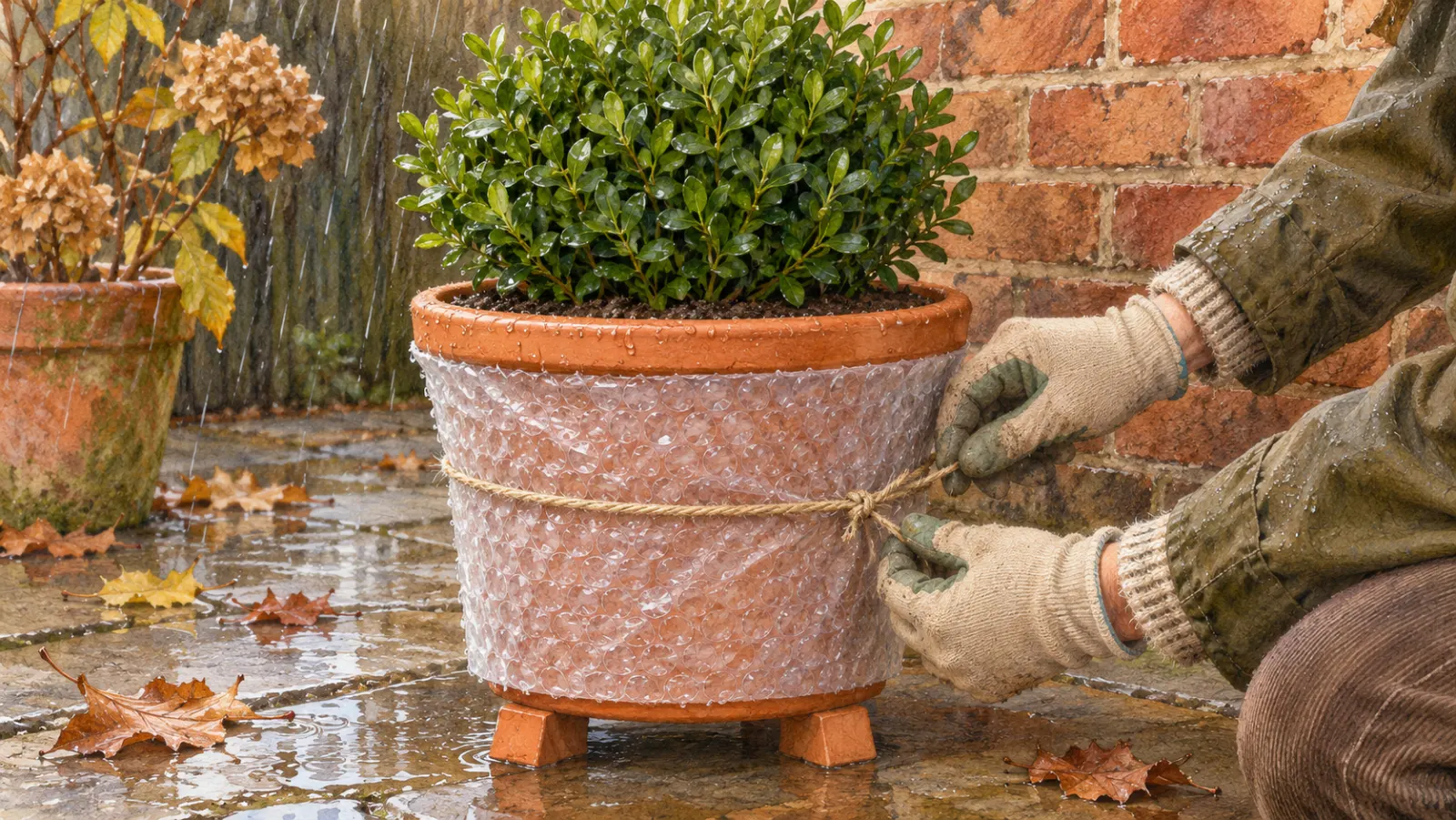
Put big pots around the outside and small pots in the middle. Pack straw or loose bark between the pots and around the edge of the group. A bale can shield a long row in a roomy yard; on a patio, bundle the pots tight enough that you don’t need one. For a tub that’s too heavy to move, wrap the walls in bubble wrap or straw. Tie the wrap so it stays on the sides in a gust. Leave the top accessible for watering and the bottom open for drainage.
Take away the saucer and raise the pot on feet or bricks if it stands on wet paving. Keep the supports stable and clear of the holes. If a decorative outer pot has no outlet, lift the nursery pot out for winter. It takes one heavy rain to turn a cachepot into a bucket.
For a budget setup, reuse loose straw between grouped pots and sound bubble wrap with twine around a single tub. The next step up is a removable, reusable container jacket, bought to fit the measured pot. The premium upgrade is a durable frost-proof planter when the existing pot needs replacing; a more expensive pot still needs a hardy plant. Choose frost-proof rather than merely frost-resistant terracotta if you want clay outdoors, or plastic with open drainage if you’ll be moving the pot. Plain terracotta can crack; metal picks up temperature swings. Empty vulnerable pots you’re not using and store them upside down.
How much wrap will you need?
Measure around the widest part of the pot and add enough length to overlap and fasten the ends. Say the round tub is 16 in (41 cm) across and the wall is 14 in (36 cm) tall. The wrap has to go about 50 in (1.28 m) around. Allow a 4 in (10 cm) overlap and cut roughly 54 × 14 in (1.38 m × 36 cm). A piece 48 in (1.22 m) long won’t close; use a longer sheet rather than leaving an exposed strip.
How cold should the garage or shed be?
For a dormant, hardy plant that’s lost its leaves, aim for 34–40°F (1–4°C) in the air beside the pots. A dark garage works for leafless hostas and deciduous shrubs; leafy evergreens need light, so choose a cool, bright porch or greenhouse for them. An attached, unheated garage or enclosed porch is a good place to try first. Use a min–max thermometer at pot height. Check it after a hard night and again after a sunny day; the spot next to the garage door can be much colder than a shelf against the house wall.
You’ll see a 20–45°F (−7 to 7°C) storage range for dormant trees, shrubs and perennials, and a 30–40°F (−1 to 4°C) range for dormant perennials. The home target keeps dormant plants cold while avoiding repeated freezing and thawing of the root ball. A nursery’s 30–34°F (−1 to 1°C) target is for potting mix, so don’t set an air thermostat to match it. If the garage swings below freezing, move pots to a steadier spot or heel in hardy ones. If it’s warm enough to bring on shoots, move them somewhere colder.
Keep leafy tender plants bright—and warm enough
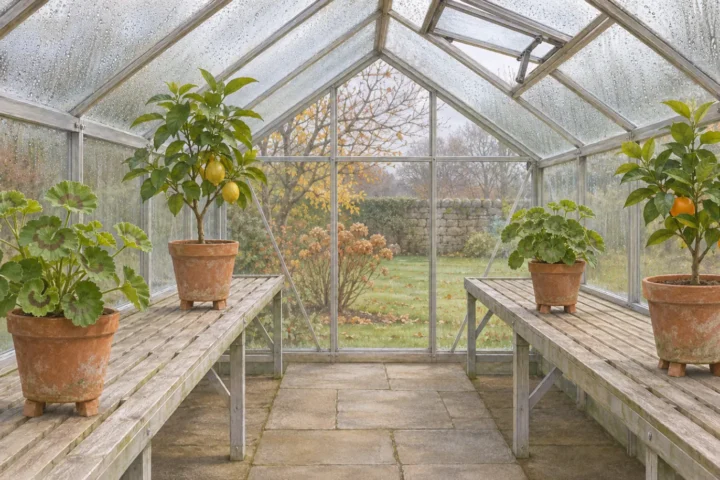
For citrus, choose a bright, cool greenhouse, glazed porch or conservatory rather than a dark shed. Some lemons tolerate 41°F (5°C), kumquats need around 45°F (7°C) or more, limes and grapefruits need above 50°F (10°C), and calamondin oranges need at least 55°F (13°C). Identify the type on the label before choosing a room. The lowest figure belongs to some lemons, not to every citrus tree.
For example, if the forecast is 39°F (4°C) and your porch thermometer falls to 43°F (6°C), move a lime into a brighter room that stays above 50°F (10°C). The porch is too cold for it even though it stays frost-free. A lemon whose nursery specifies a 41°F (5°C) minimum could use that porch.
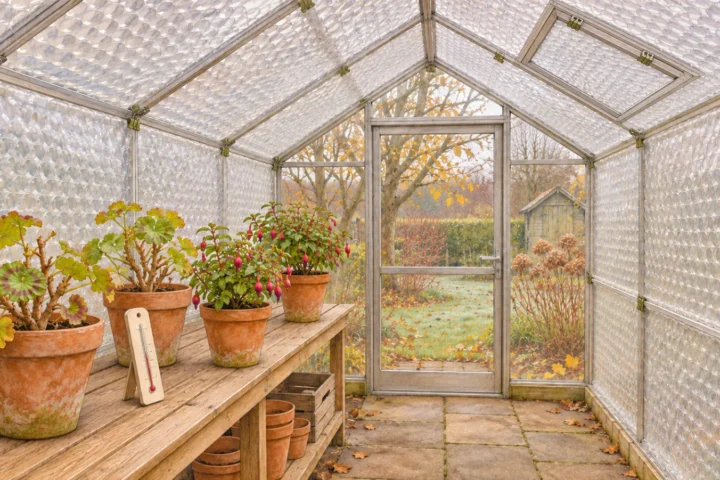
For evergreen agapanthus, choose a cool, light, frost-free space before frost arrives. If a greenhouse is the available shelter, measure its overnight low. Bubble lining slows heat loss, but a tender plant still needs a space that holds its minimum. If condensation is dripping onto the foliage, adjust watering and ventilation.
Dahlias and cannas need a different storage routine
For potted dahlias and cannas, the default in a freezing winter is to lift their storage organs after frost has killed the foliage, dry them, and keep them frost-free. Store dahlia tubers and canna rhizomes at 40–50°F (4–10°C). Label them and inspect periodically for rot or shriveling. Use the linked species instructions for cleaning and packing; these aren’t the cold, moist pots in the garage chart.
Check the soil through winter, then unpack in spring
Before storage, remove dying leaves and debris that can harbor gray mold, then water dry mix and let the excess drain. Let foliage dry before fitting any cover. Evergreens such as boxwood can lose moisture from their leaves in winter, so give their pots particular attention. Don’t judge by the weather alone. A tub under the eaves may be dry while the path beside it is soaked.
Check grouped outdoor pots every two weeks and buried ones monthly when accessible. In a cold garage, check often enough to catch dry mix; in mild spells you may need water every two to three weeks. Treat these as inspection intervals, not a watering timetable. Feel below the surface. If the mix is dry, water when it has thawed and can drain; outside, pick a mild day above 40°F (4°C). Skip frozen or soggy pots. For sheltered citrus, let the surface partly dry before watering thoroughly and draining the pot. After a storm, retie loose wraps and clear clogged drains.
When wrapping isn’t enough: if a plant lacks the two-zone hardiness margin or a prolonged freeze is forecast, bury hardy plants or move them to measured cold storage while you can still lift the pots. A wrap slows heat loss; without a heat source, the root ball keeps cooling toward the surrounding temperature. No single outdoor temperature is safe for every wrapped pot. Frost-cloth temperature claims describe a different covering and setup, so don’t add them to your forecast as a pot-wrap allowance.
Pull back straw once the worst cold has passed, before you see new growth. Remove chips as soon as they’ve thawed enough to pull away and lift sunken pots when the bed is workable. That’s often a few weeks before the last frost. Unpack patio clusters in stages if the weather is still unsettled. Plants that spent winter in bright shelter should get used to outdoor conditions over two to three weeks. Bring tender pots back in when the forecast approaches their minimum; frost-free isn’t warm enough for every citrus tree. For hardy plants already pushing soft new leaves, keep frost cloth (horticultural fleece) handy for a late frost.
Leave the thermometer beside the pots tonight. Read the minimum in the morning before moving the rest of the collection into that spot.