How to Grow Winter Spinach in an Unheated Greenhouse
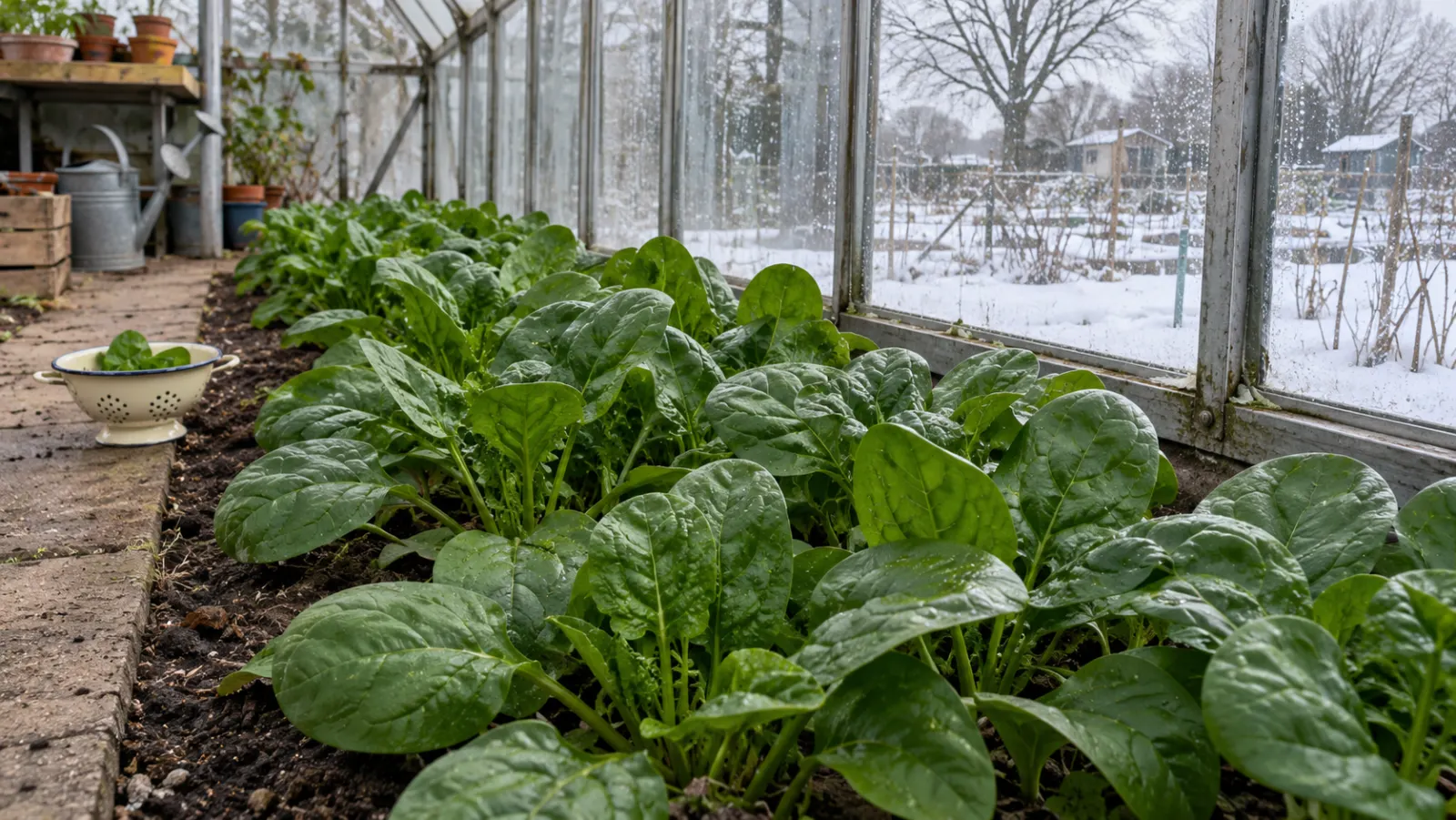
If your spinach already has leaves large enough to pick, you can harvest it in an unheated greenhouse through winter thaws. Small, well-rooted plants are better saved for early spring. And if the bed is empty and days are already shorter than about ten hours, save most of your seed for late winter. The roof keeps out wind and rain. It can’t give you a longer day.
The same plan works in a hoop house or polytunnel. A bed that’s full of spinach and a bed you’ve just cleared of tomatoes call for different jobs this week.
Pick, hold, or sow?
| What’s in the bed? | What to do |
|---|---|
| Full plants, leaves have thawed | Pick some outer leaves |
| Small, rooted fall plants | Keep them for spring |
| Empty, about six weeks before short days | Sow for winter picking |
| Empty, one to three weeks before short days | Sow for spring picking |
| Empty, daylight already below ten hours | Save seed for late winter |
Think of the leaves already on the plant as your winter supply. You might get some regrowth in a bright, mild spell, but a bowl taken every few days can empty the row faster than winter can refill it. Small plants that have rooted into the bed can sit through the slow stretch and start up again as conditions improve.
Find your two sowing windows
Look up sunrise and sunset for your location and find the last fall day with about ten hours between them. For leaves to pick in winter, count back about six weeks. Allow five to eight weeks: use six as your starting point, or sow seven to eight weeks ahead in a shaded house or an early-cooling bed. Short days reduce the hours available for photosynthesis; cold soil slows growth too, so the same sowing date can give very different results. You want plants with leaves worth picking before light and warmth fall away.
For spring leaves, you can direct sow one to three weeks before the same autumn date if the bed is still workable. That later sowing is meant to carry small plants over winter. If you’ve already missed it, start around the first ten-hour day on the way back up, once the bed has thawed and drained. In the seed grower’s Maine guidance, crops sown as days reached that length again took about six to eight weeks to reach harvest size.
Say your local short-day stretch starts around November 12 and ends around January 30, as in one Pennsylvania example. Six weeks back puts winter-harvest sowing around October 1. October 22 to November 5 is the later slot for spring. If you clear the tomatoes on November 13 and have an empty bed, leave most of it unsown until around the end of January and wait longer if the soil is frozen or sodden. Start a short trial row sooner only if your greenhouse still has a workable, bright bed and you can spare the space for plants that may sit there until spring.
If your shortest winter day stays above ten hours, skip this countdown: sow in the cool season while the bed is workable, and use the growth temperatures below to judge conditions. In a mild maritime winter, from coastal British Columbia to Ireland or Atlantic Europe, thawed leaves may be available more often, but a run of gray days still slows replacement growth. In an inland freeze that keeps the bed or leaves frozen through the day, expect breaks in picking. Put a minimum thermometer at leaf height, where the spinach is.
What a later planting actually cost in time
For a northern, cold-winter benchmark, these were the six seed-to-transplant schedules in the New Hampshire trial. Use the daylight countdown above to adapt them to your garden.
| Sow | Transplant | Plan your picking |
|---|---|---|
| Aug 29 | Sep 20 | Winter and spring |
| Sep 8 | Sep 30 | Winter and spring |
| Sep 18 | Oct 9 | Some winter; spring |
| Sep 29 | Oct 19 | Aim mainly for spring |
| Oct 9 | Oct 30 | Aim for spring |
| Oct 19 | Nov 9 | Aim for spring |
In a two-winter New Hampshire tunnel trial, the same November 9 transplant date gave a first harvest in 39 days one year and 130 the other. Those were plugs about three weeks old, so sowing from scratch on that date starts further behind. The earliest transplant produced roughly two to two and a half times as much over the whole season as the latest. For spring yield alone, the first four dates, from September 20 through October 19, were similar in the trial. The late October and early November transplants still gave a useful spring crop. For winter picking, give spinach bed space early; a late-cleared bed is better aimed at spring.
Choose winter seed and leave room to pick
Buy a packet labeled hardy or suitable for overwintering. Giant Winter is grown for picking in the coldest months in Britain. Space and Regiment outyielded Tyee in the New Hampshire trial. Corvair and Renegade did well during the coldest months among the extra varieties tested at the October 9 transplant date. For a cold-winter first try, pick Space or Regiment if available; Tyee’s curled leaves were more brittle to handle. Carmel bolted before the second trial ended, so it is a weaker choice for carrying this crop into spring. If your shop lists none of those, buy a locally available hardy spinach and look for downy mildew resistance if that disease has been a problem. Look for Spinacia oleracea on the packet. Perpetual spinach is leaf beet and follows its own schedule.
Choose the brightest winter bed and clear weeds before sowing. Spinach needs fertile soil that holds moisture: work in mature compost before planting, and base extra fertilizer on a soil test rather than automatically feeding a bed that has just grown tomatoes. Direct sow into a fine, moist bed if it’s ready. Follow the packet for depth. Two useful guides use ½ in (1.3 cm) and 1 in (2.5 cm). Use the shallower depth in a fine bed that stays evenly moist. Leave about 8 in (20 cm) between rows so you can get a hand in to pick. Thin to 3 in (7.5 cm), then take alternate plants young and leave the rest at 6 in (15 cm) for repeated harvests. Closer spacing suits a quick baby-leaf cut, but gives each plant less air and room to pick from later.
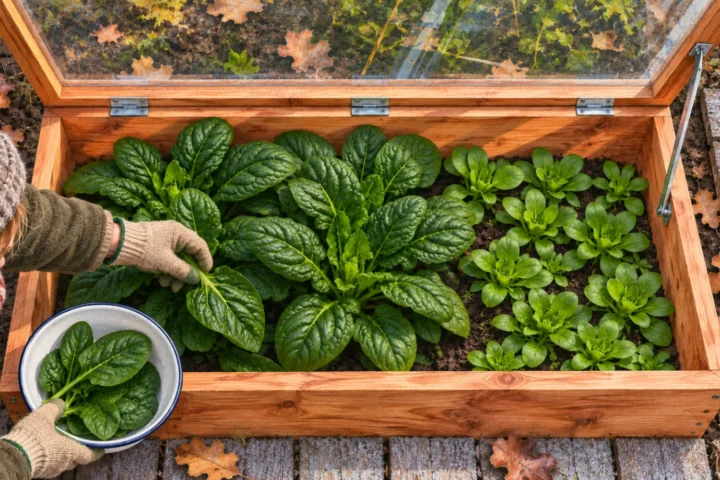
Still waiting for the tomatoes to finish? Start spinach in cells and move the plugs with the root ball intact. About three weeks gave transplantable seedlings in the New Hampshire trial. When late-summer heat spoiled germination, the researchers used 60°F (16°C) for seven days. If the greenhouse is still hot enough for the tomatoes to ripen, put the seed tray somewhere cooler until the seedlings emerge. Set plugs 6 in (15 cm) apart for easy repeated picking; the trial used 5 in (13 cm). Water them in. In a house without a soil bed, choose a pot at least 1 ft (30 cm) wide and deep. You can also move an autumn-sown pot under cover before hard weather arrives. If you only have room for a low box, an established row can also overwinter in a cold frame with a lid you can vent.
Baby leaves can be ready in a month and mature leaves in about two months in good conditions. Give yourself longer if the crop is heading into short days. Check whether the packet counts from sowing or transplanting, especially when you compare a plug crop with a direct-sown row.
Cover for freezing nights and uncover for light
When the thermometer inside the house starts to show repeated freezes, set a lightweight sheet of frost cloth (horticultural fleece) over low hoops. Start with 19 g/m² (0.55 oz/yd²) cloth for this inner layer, the weight used in the New Hampshire tunnels. Keep it off the leaves. The points where it touches can suffer frost damage. Weight the edges at soil level and leave a side you can lift for picking. Keep the hoops low enough to shelter the bed and high enough that wet cloth can’t sag onto the plants. Measure the sheet over the hoops before buying so you have enough left to close the sides.
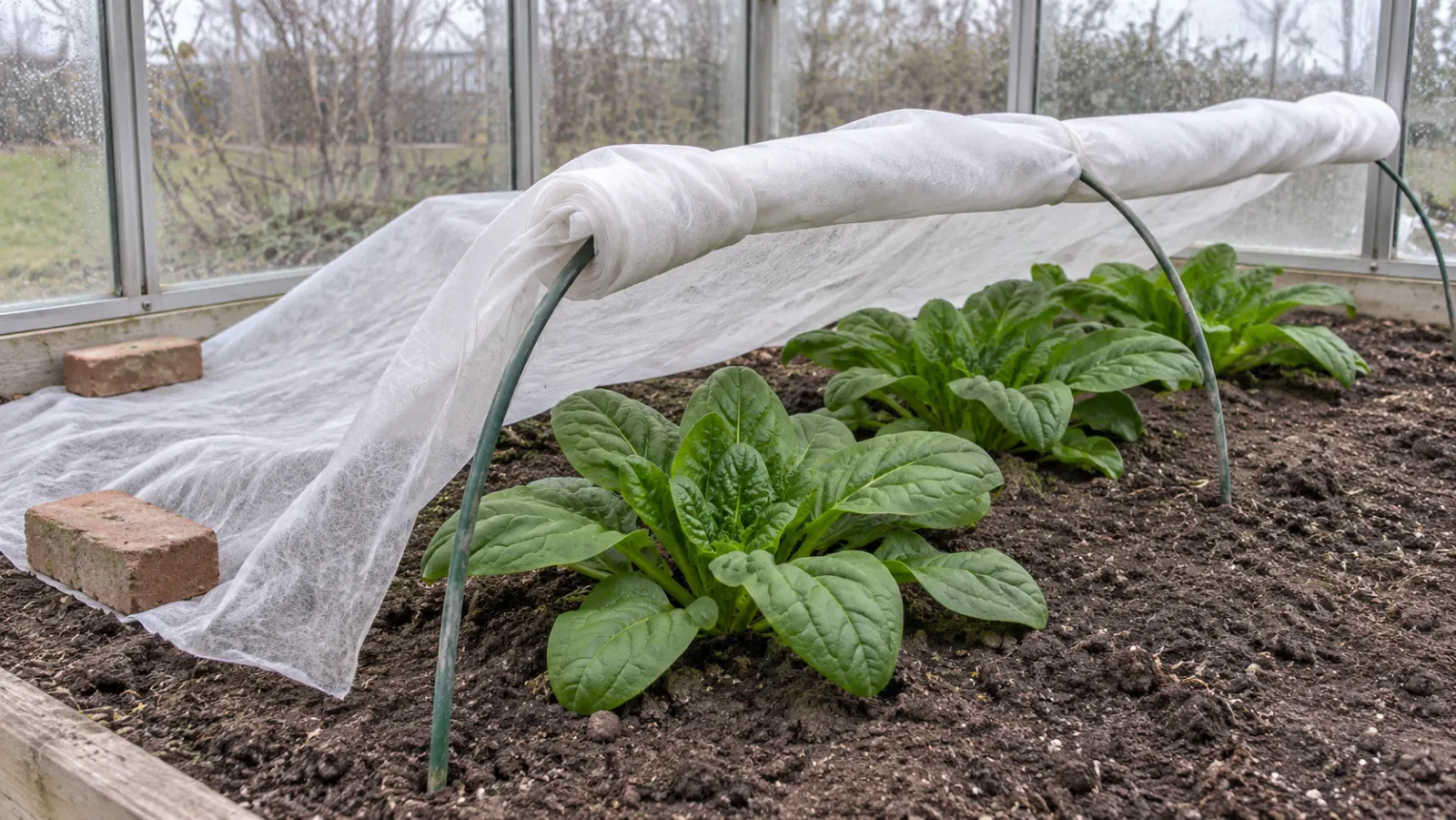
Roll the cloth back on mild days once the leaves have thawed. Ohio growers using an outdoor low tunnel lift the cover in the 40s°F (about 4–9°C); in a greenhouse, read the thermometer inside the house. On a day that stays near freezing, leave the cloth in place. Once spring days regularly reach 50°F (10°C), the New Hampshire growers removed their inner cover for the season; keep yours handy for a late freeze. Put it back before the house cools for the evening. Some row covers reduce light by about a third; the loss depends on fabric weight. That’s a reason to uncover in mild weather, rather than leave extra layers on all winter.
Open a vent early on sunny days, as the uncovered bed warms toward 60°F (16°C). Aim for 60–65°F (16–18°C) for leafy growth and vent before 75°F (24°C). A sunny house can get there quickly. On a mild, damp day, vent to dry the foliage even if the house stays cooler. If you have a humidity meter, sustained readings above 85% relative humidity are another prompt to improve air exchange. If water keeps dripping from the glazing, work through the winter condensation checks.
Push a finger into the soil before watering. If it’s still moist below the surface, leave it. Snow outside can hide a dry bed under glass, and winter crops sometimes still need watering, as the New Hampshire trials did. Give dry soil a drink at the roots in the mild part of the morning, when the bed can absorb it and stray splashes have time to dry. Use a watering can with the rose off for a short row or drip for a longer bed. A moist root zone helps; wet leaves shut under a damp cover give downy mildew better conditions.
When the greenhouse and inner cover reach their limits
The house can warm sharply in sunshine yet fall close to the outdoor minimum overnight. Frost cloth slows heat loss; it doesn’t supply heat. Established spinach can tolerate 15–20°F (−9 to −7°C), while small seedlings and fully mature plants are more vulnerable. Treat nights approaching 20°F (−7°C) at leaf height as a reason to add temporary protection, not as a picking forecast. Outdoor winter beds call for heavier fabric, 31–51 g/m² (0.9–1.5 oz/yd²), rather than treating this lightweight inner layer as their only protection. A heavier cover gives more insulation but less light; reserve it for the cold spell, then return to the lighter inner layer. If the bed stays frozen all day, pause harvesting and sowing until it thaws. Use only a greenhouse or tunnel built to withstand your local winter snow and wind.
Harvest in thaws and replace the crop as it bolts
Wait until the leaves thaw. On a cold, gray day, that may mean coming back another day. Pinch a few outer stalks near their bases and leave the central leaves growing. A useful picking size is 4–6 in (10–15 cm), measured from stalk base to leaf tip. In that trial, picking was about every two weeks in much of the season and only once a month in January and February. Use the size of the leaves in front of you to judge your next picking, especially if the row is still sparse. Cold weather raised leaf sugar measurements in the tunnel trial; Gazelle and Emperor ranked highest on average, but there was no raw taste test. Choose seed for winter performance before chasing a sweetness ranking.
While you have the cover up, remove slugs from under the lowest leaves and inspect the undersides for aphid colonies. If seedlings disappear or are cut off at soil level, look for cutworms around their bases; the tunnel trial had both cutworms and aphids. Pull small weeds before they compete with the crop. Remove yellowing lower leaves as you tidy. Yellow patches with gray or purple fuzz beneath point to spinach downy mildew. Remove affected leaves promptly and remove severely affected plants. Clear the debris from the bed and thin crowded rows to improve air circulation.
As growth picks up you can take a larger cut. If you switch to cutting across a row, cut above the growing point so the plants can regrow. Once a central flower stalk starts to extend, pull the plant. A stem that’s starting to stretch is an easier sign to spot than the bitter leaves you’ll get later. Sow a fresh batch of spinach when the spring bed is workable so it’s coming on while the old plants are still productive. Mark your fall sowing date and first winter picking on the packet: next year you’ll know whether your bed needs an earlier start.